Thursday, September 22, 2011

Talos sampsoni


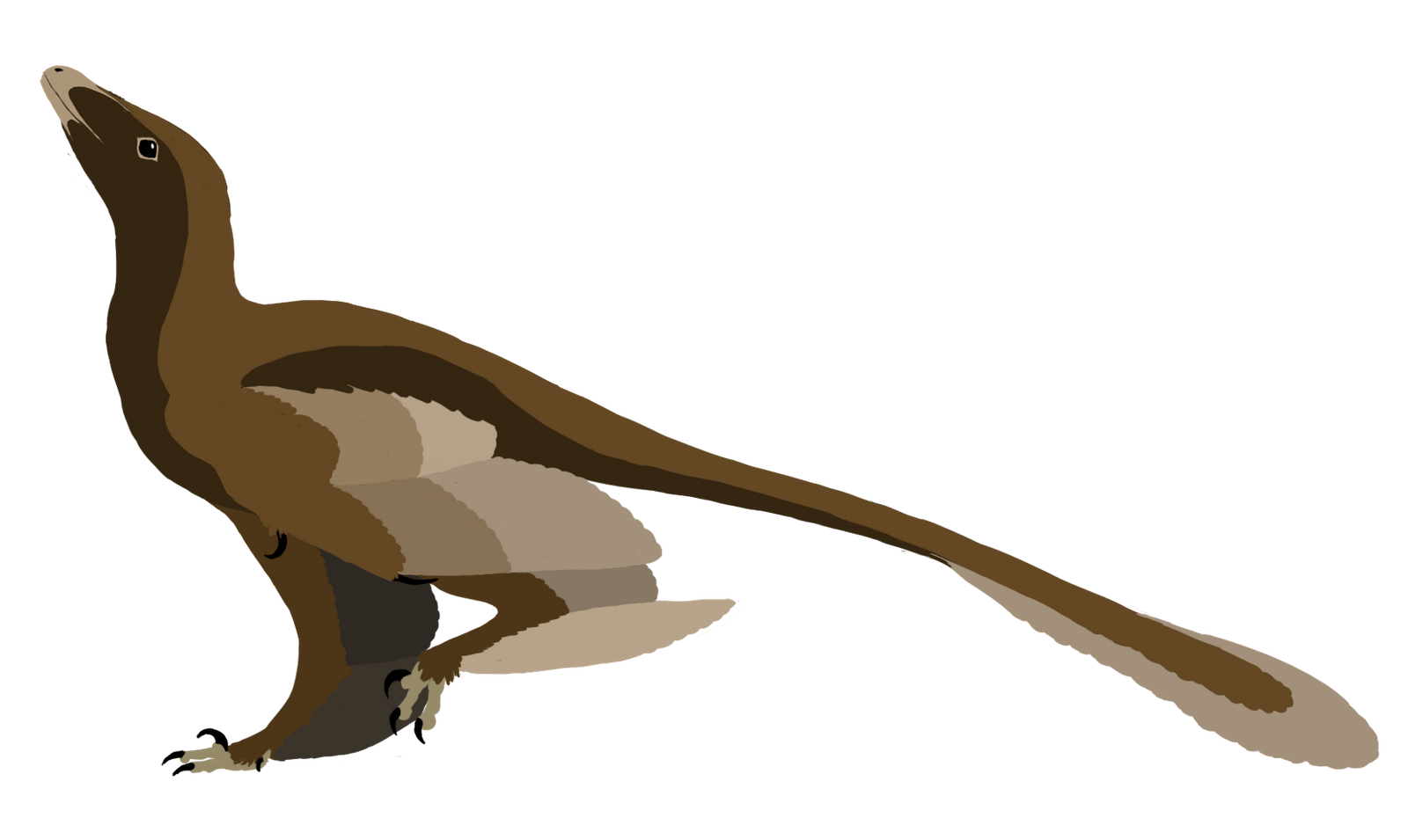
This is the newly described troodontid Talos sampsoni of Utah's Kaiparowits Formation. The described specimen of this derived troodontid had an interesting feature, which is that the sickle claw-bearing toe of the left foot had been broken in life, including a surface lesion, and had then healed. The authors speculate that the toe may have been damaged in some sort of physical trauma or infection. A popular theory is that it was damaged in the act of predation, though that remains a speculative idea.

Here I've reconstructed it inspecting the hurt toe after the injury had occurred, perhaps cleaning it as best as it was able.

The paper is open access, so please feel free to read more about it here.

Saturday, July 16, 2011

Saurornitholestes langstoni


Saurornitholestes, a remake of an earlier image.

Around a year ago there was a new discovery involving fossilized scratch marks, presumably from the foot claws of a maniraptoran, at the entrance to an ancient primitive mammal burrow. I illustrated it at the time and some of you may remember it. However more recently a museum representative from Denver contacted me wanting a larger resolution version of the piece, so I updated it accordingly and added some additional details for accuracy and interesting-ness, including the trio of Pteranodon longiceps from a recent submission. (This is not the highest resolution, obviously, but I think the improvement in detail is noticeable.)

To reiterate the study:

The scratched-out burrows provide a unique insight into both the behavior and diet of these dinosaurs, which must have occasionally dug out the burrows of their prey, like many modern predators do. This trace fossil was found in Utah and is dated at around 80 million years old, which means the claw marks could belong to several different small dromaeosaurs or troodonts. I've illustrated the dromaeosaur Saurornitholestes here, which was similar in size and anatomy to Velociraptor. The findings were published in the journal Geology.

Thursday, July 14, 2011

Microraptor


Microraptor sitting on a branch. Quick sketch from class today, nothing special. Done without references, so possibly inaccurate.

Wednesday, June 29, 2011

Pteranodon trio


A trio of Pteranodon longiceps, two males and one female. Portion of an upcoming larger piece.

Photoshop CS4.

Sunday, June 12, 2011

Callobatrachus


Something that's not a dinosaur, for once. This is the prehistoric frog Callobatrachus from Early Cretaceous of northeastern China. This will be the prey animal that Sinornithosaurus is eating in the Liaoning scene I'm working on. I also put it in the Wikipedia article on the animal, which I also wrote.

Saturday, June 11, 2011

Sinornithosaurus poses

In slowly completing a large, detailed Liaoning scene, I've been working on a sinornithosaurid. I have two poses I'm trying to choose between:


The top one is looking up passively at two Microraptors as they swoop down from above. The lower image is meant to be a bit more dynamic, and will be drawn protecting either a nest or mantling over a kill (perhaps a snake or a small mammal). I can't think of having seen artwork of a dromaeosaurid mantling. This is a behavior typically observed by birds of prey after making a kill: they will spread their wings and tail and crouch over it, looking menacing to anyone nearby who might consider stealing it.


I think I like the bottom one better.

Keep in mind that these are not meant to be representative of Microraptor gui and Sinornithosaurus millennii specifically, as those two species are from two different formations (Jiufotang and Yixian, respectively). Even though the species likely did not overlap, I think it's perfectly reasonable that the genera may have.

Microraptor T-shirt?


This is technically a work in progress for a much larger, more complex image, but I thought that the basic design was snazzy enough that I made a t-shirt out of it. Definitely the one thing missing from everyone's lives, a Microraptor t-shirt.