Sunday, December 30, 2012

The Evolution of a Microraptor

I've actually had a few people recently comment on my accurate cast shadows in my artwork, so I thought I'd share a little secret.

I have some difficulty composing accurate cast shadows in my head, though I've gotten much, much better at it over the years, thanks in large part to Jon who has been tirelessly critiquing my shading since 2006. He has an almost uncanny ability to rotate three-dimensional objects in his head, an ability that I don't have to quite that degree. However, I have more recently acquired an additional skill in my toolbox for shading, something I learned from the great James Gurney.

Recently I set out to reconstruct a four-and-a-half-year-old picture of mine that had fallen far out of date both in terms of accuracy and artistic proficiency:


This picture was drawn for a publication that, then in its infancy, is now finally bordering on the cusp of maturation, but after the Microraptor color study I knew I had to redo this one to bring it up-to-date. I wanted the composition to remain nearly the same, but the animal itself needed a makeover, and this included the cast shadow.

Lo and behold - I'm actually not terrible at sculpting. Who knew?


Of course, this sculpt involved just the barest of details, and will probably never be "completed" in the sense of being a finished sculpture, but I did my best to make it anatomically accurate and it certainly served its intended purpose. The basic lateral anatomy is based on the original drawing in Xu Xing 2003:


And then beefed up with what I know of dromaeosaurid and bird anatomy with a very lightweight type of modeling clay.

Using the guideline of the model, I could then create the finished image with cast shadows intact.
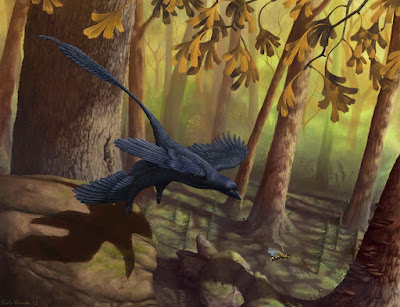

Obviously this sort of process is far too time-consuming to use on everything I draw, but it's kind of fun for more important paintings that need to be as accurate and consistent as possible.

Sunday, November 25, 2012

'All Yesterdays' Book Review

Many of you are probably aware of the new paleoart book All Yesterdays, written by Darren Naish of TetZoo, John Conway, C.M. Koseman, and Scott Hartman, and illustrated by the latter three. Right now only the Kindle edition is available on Amazon, but the print version should be out soon, last I asked. In any case, I'd eagerly awaited this book for some time, and wanted to write a review for Amazon after it was released. I thought I'd post my review here as well in the hopes of inciting the interest in my paleo-minded followers.


Conway's illustration of Protoceratops in a tree serves as the book's cover, and demonstrates the idea that animals can do things they don't necessarily do all the time

Sunday, July 29, 2012

The Neck is a Lie

Matt Wedel of SV-POW has a pair of old articles on how necks lie, illustrating in a general sense that the skeletal structure of an animal is often at odds with its physical appearance. No part of the skeleton emphasizes this discrepancy more than the neck, especially in birds. These have always been some of my favorite SV-POW posts, not just because of how crazy it is to see a budgie's cervicals overlap its trachea, but because the prevaricative nature of the neck has a great deal of application to paleontographic reconstructions of dinosaurs.

Ardeidae, the heron family, demonstrates an excellent variety in neck shapes and neck capabilities. Most of us are familiar with larger heron species, like the great blue and the great egret. Both of these birds are very large, and have extremely long, serpentine necks. But these necks don't lie - by paleontography standards, they are almost "shrink-wrapped" in appearance, and clearly show the accurate contour of the vertebral column.


Look at that glorious S-curve.

Wednesday, July 18, 2012

The Rains of Rögling

Here is my rendition of the purported baby megalosauroid, Sciurumimus, perched on a rock by the Bavarian sea as it waits patiently for its mother to return to it. Two pterodactylid pterosaurs comb the beach in the background. From the late Jurassic Rögling Formation of Germany, ~150 mya.

Tuesday, June 19, 2012

Deinonychosaur footprints

My newest illustration was finally released today, so I'm free to upload! This is an illustration for discovery of a series of new trackways of deinonychosaur footprints from the Liujiaxia Dinosaur National Geological Park, Yongjing County, Gansu Province in China. The footprints range quite a bit in size, indicating several different taxa which could include troodontids as well as dromaeosaurs. Some are found in close proximity to titanosaur footprints (drawn based on Huanghetitan here). The deinonychosaur is represented here as a dromaeosaur genus similar in size and morphology to Deinonychus. Detail of deinonych:

Thursday, June 14, 2012

Bird Panoply

Set of small bird illustrations of common birds of the NJ area.

Deinonychus with Wren

Just a teensy little sketch drawn into my dad's card for Father's Day, but I thought it was cute enough to scan.